
Does Age Gap Actually Matter in a Muslim Marriage?
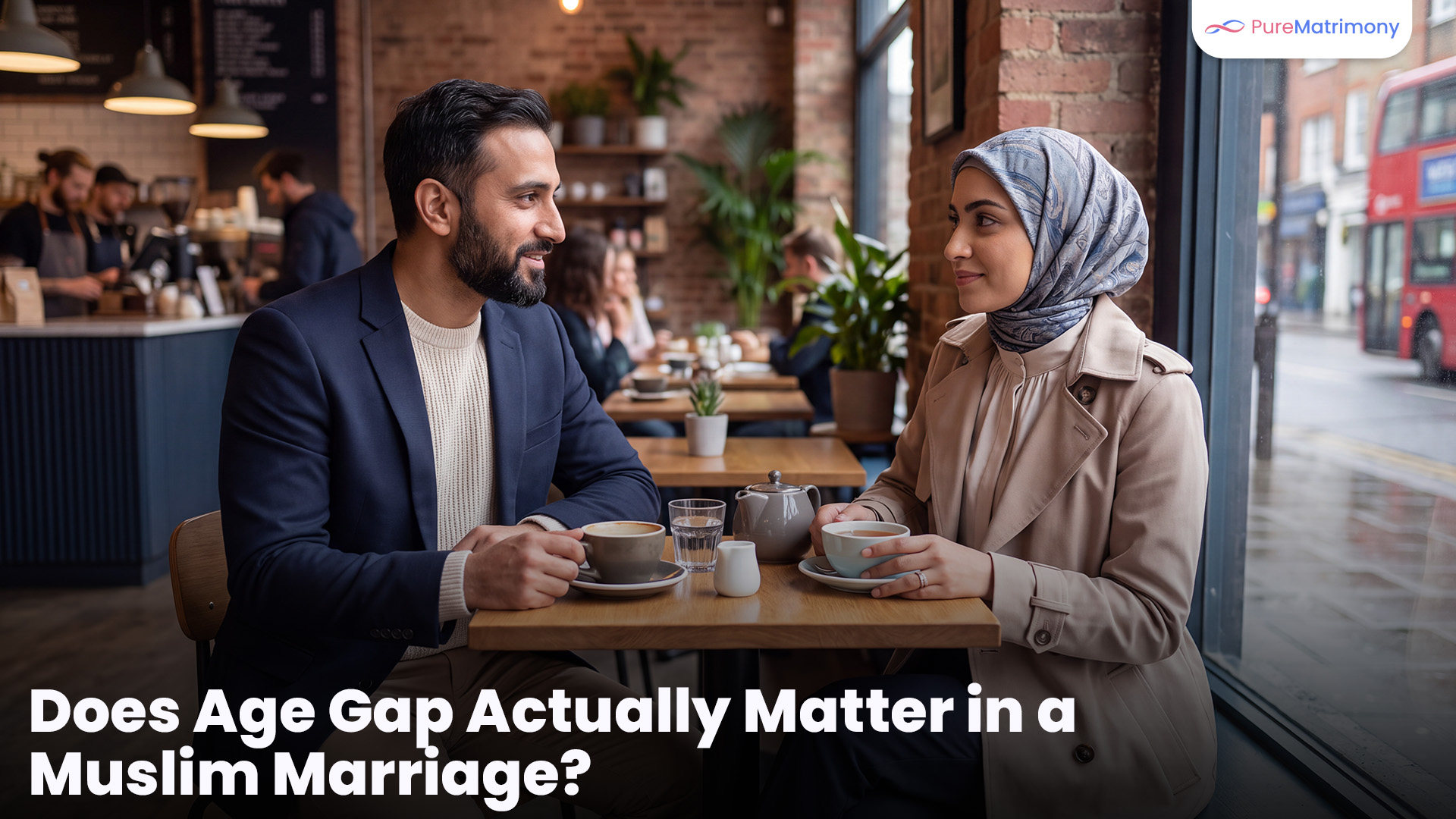
For single Muslims, age often becomes one of the first numbers considered when assessing a potential spouse.
Families may have preferred ranges, matrimonial profiles include age filters, and some people assume that a smaller age difference automatically creates better compatibility.
But does age gap actually matter in a Muslim marriage?
The answer is yes, but probably not in the way many people think.
Islam does not establish one universal ideal age gap between spouses.
Age can influence lifestyle, health, family planning, energy levels, and long-term expectations, but Deen, character, maturity, attraction, communication, and shared goals are usually far more important when deciding whether two people can build a successful marriage.
Read More: Comparing Marriage Age Then and Now: What Is Actually Changed?

What Does Islam Say About Age Difference in Marriage?
Islam does not prescribe a specific number of years that should separate a husband and wife. The emphasis is placed on suitable character, faith, consent, and the ability to fulfil marital responsibilities.
When assessing marriage, Muslims sometimes become focused on criteria created by family or culture rather than requirements established by Islam.
The Prophet Muhammad ﷺ encouraged consideration of religion and character when evaluating a marriage proposal. Jami at Tirmidhi records guidance to accept a suitor whose religion and character are satisfactory.
That guidance is significant because age is not presented as the defining measure of suitability.
Likewise, the Quran reminds believers that true honour before Allah is based on righteousness rather than social categories or background. Surah Al Hujurat, 49:13.
Age may matter practically, but it should not automatically outweigh stronger indicators of marriage compatibility.
Does Age Difference Really Matter in Marriage?
Age difference matters when it creates meaningful differences in life stage, expectations, health, priorities, or future plans. The number itself matters less than what that number means for the couple.
Consider two people who are seven years apart.
They may have nearly identical priorities, energy levels, religious practice, and plans for family life.
Another couple separated by only two years may disagree completely about children, careers, finances, culture, and lifestyle.
This is why age alone tells you very little.
A more useful question is:
Are we at compatible stages of life?
That includes questions about:
- Marriage readiness
- Career stability
- Children
- Financial priorities
- Physical health
- Lifestyle
- Family responsibilities
- Retirement expectations
- Social preferences
- Long-term location
The age difference becomes relevant when it affects these areas.
What Is an Acceptable Age Gap in Muslim Marriage?
There is no single Islamic rule stating that three, five, ten, or any other number of years is the correct age gap for marriage.
Families may have preferences based on culture, experience, or practical considerations. Those preferences can be discussed, but they should not automatically be treated as Islamic requirements.
Instead of asking whether an age gap is socially normal, ask whether both people:
- Freely want the marriage.
- Understand each other’s stage of life.
- Have compatible expectations.
- Are emotionally mature.
- Can fulfil their responsibilities.
- Share important religious and family goals.
- Feel comfortable with the difference.
If the answer to those questions is positive, the age number may be less important than initially assumed.
Can a Large Age Gap Affect Compatibility?
Yes. A larger age gap can create practical differences that couples should discuss honestly before marriage, but it does not automatically make the relationship unsuitable.
Age may influence everyday married life in several ways.
Different Life Stages
One spouse may be establishing a career while the other is already settled professionally.
One may want to travel and explore, while the other prefers greater stability.
Neither preference is wrong, but the difference needs discussion.
Children and Family Planning
Couples should discuss whether they want children, when they hope to have them, and whether age could affect their plans.
These conversations should happen before marriage rather than after assumptions have already been made.
Health and Energy
Age can affect health, energy, and physical lifestyle over time.
Someone considering a significant age difference should think beyond the wedding and consider what life might realistically look like ten, twenty, or thirty years later.
Social Expectations
Friends and siblings may belong to different age groups. Interests and social routines may also differ.
Again, none of these factors automatically prevent a successful marriage.
They simply require honesty.
Can the Younger Spouse Still Be More Mature?
Yes. Age and emotional maturity are related only loosely. Someone older is not automatically wiser, more responsible, or better prepared for marriage.
Marriage readiness depends on behaviour.
Look at whether someone can:
- Manage anger
- Accept correction
- Communicate difficult feelings
- Keep commitments
- Handle money responsibly
- Respect boundaries
- Make decisions thoughtfully
- Consider another person’s needs
- Take responsibility for mistakes
A person can accumulate birthdays without developing these qualities.
Similarly, a younger adult may demonstrate considerable emotional maturity, discipline, and responsibility.
For singles, maturity should therefore be observed through behaviour rather than assumed from age.
What Should Single Muslims Consider Besides Age?
Single Muslims should assess faith, character, attraction, communication, lifestyle compatibility, family expectations, and future goals before giving excessive importance to age.
A useful compatibility discussion should cover:
| Area | Questions to consider |
| Faith | Do we practise Islam in compatible ways? |
| Family | How involved will our families be? |
| Children | Do we agree about whether and when to have them? |
| Finances | How do we approach earning, spending, and saving? |
| Career | Could either person’s ambition require relocation or major changes? |
| Lifestyle | Do our routines and social preferences fit together? |
| Communication | Can we discuss difficult subjects respectfully? |
| Future | Do we imagine similar lives in ten or twenty years? |
These questions reveal much more about spouse compatibility than age alone.
When Should an Age Difference Be Taken More Seriously?
Age deserves greater attention when it significantly affects major decisions or creates an imbalance that either person is uncomfortable with.
Think carefully when:
- One person wants children soon, and the other does not
- Career stages are dramatically different
- One spouse expects the other to change their lifestyle completely
- Health considerations could substantially affect future responsibilities
- One person uses greater age as justification for control
- Family expectations differ because of life stage
- Either person feels pressured to accept the difference
Respect is particularly important.
Being older does not give one spouse permission to dismiss the younger person’s opinion or treat them as inexperienced.
Marriage requires consultation, dignity, and mutual consideration.
Should You Change Your Age Preferences When Searching?
You do not need to abandon your preferences, but it can be useful to understand why you have them.
Ask yourself:
Why have I selected this age range?
Perhaps you genuinely want someone at a similar stage of life.
That is reasonable.
But perhaps the preference exists mainly because:
- Your family expects it
- Your friends married someone similar in age
- You assume older always means mature
- You assume younger always means easier compatibility
- You have never considered alternatives
Knowing the reason behind your preference helps you decide whether it is essential or simply familiar.
Read More: What It Actually Feels Like to Be Single and Waiting
Age Is One Part of Compatibility, Not the Whole Picture
When searching for marriage, it is easy to focus on information that can be measured quickly: age, height, profession, education, and location.
The strongest marriages require qualities that are harder to place inside a search filter.
- Patience.
- Mercy.
- Responsibility.
- Trust.
- Shared Deen.
These qualities tell us far more about the purpose of Muslim marriage than the number of years between two birthdays.
Final Thoughts
Age gap can matter in Muslim marriage, but it should be evaluated as part of compatibility rather than treated as a universal test of suitability.
Islam does not establish one ideal age difference.
For singles, the better approach is to ask whether the age difference creates genuine practical concerns.
Are you at compatible stages of life?
Do you want the same future?
Can you communicate respectfully?
Are you comfortable with the difference?
Do you share important values?
Does the person’s character give you confidence?
If those foundations are strong, an age difference may be entirely manageable.
If they are weak, being exactly the same age will not repair them.
Look Beyond the Number When Searching for a Spouse
Choosing a spouse requires more than matching an ideal age range.
Pure Matrimony helps practising Muslims explore compatibility and marriage goals while keeping the search focused on serious intentions.
Look for someone whose character and vision for married life genuinely complement your own.