
How to Search for a Spouse on Pure Matrimony?
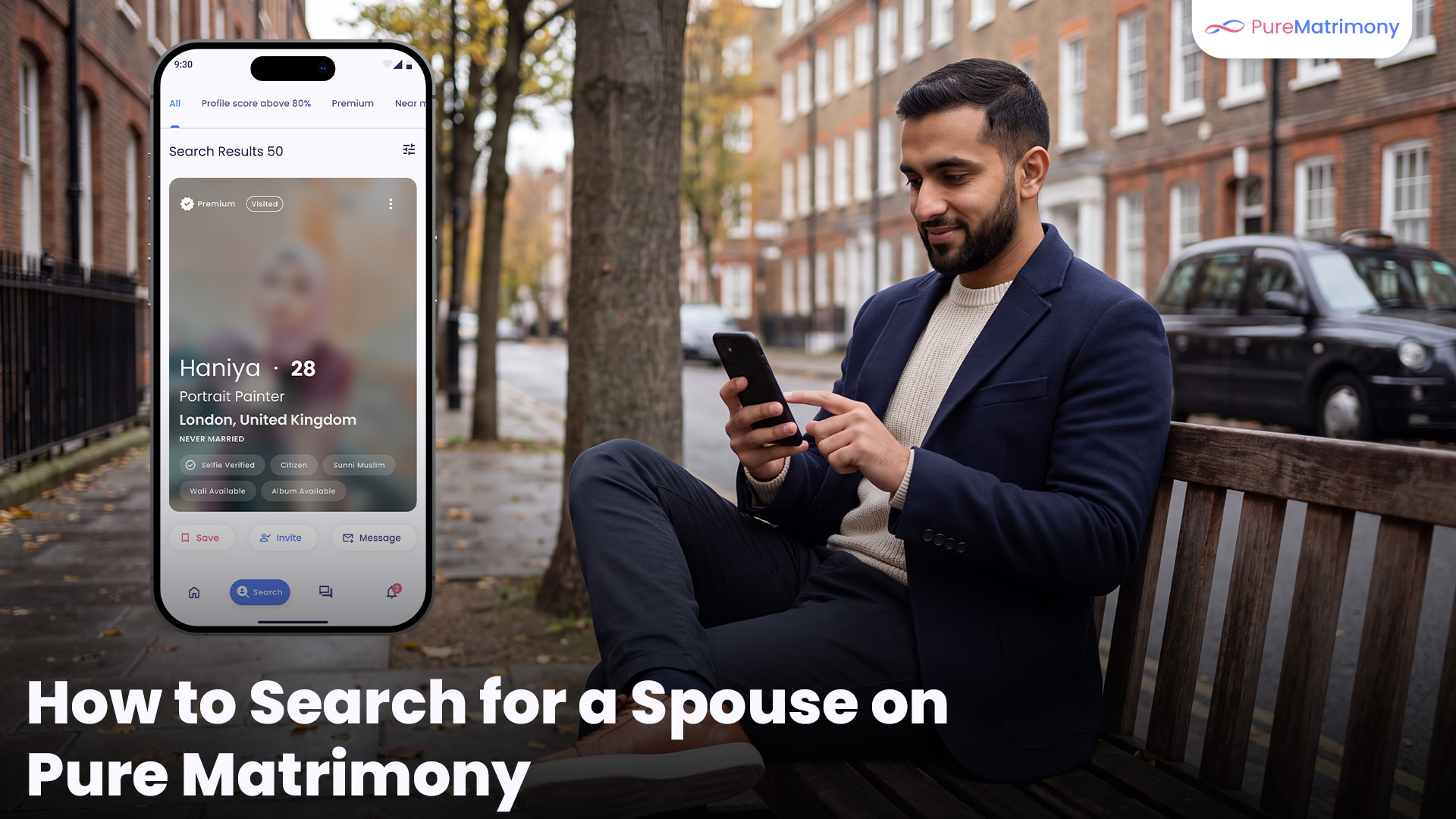
A successful spouse search starts with knowing what you are looking for, what you bring to a marriage, and how to recognise genuine compatibility.
Searching for a spouse can quickly become confusing when every potential candidate feels like another possibility to assess.
The answer is not necessarily to consider more people.
It is to approach each stage more thoughtfully.
Whether you are beginning your search or returning to it after a break, your behaviour matters.
The way you define your priorities, present yourself, communicate, ask questions, and make decisions can affect the quality of your search.
Here is how to approach the process with true intention.
Read More: Why Pure Matrimony Is Better Than Other Marriage Apps

1. Know What You Actually Want From Marriage
Before looking for a spouse, identify the kind of marriage you want to build.
Start with the bigger picture rather than a list of superficial preferences.
Ask yourself:
- What role will Islam have in my household?
- What kind of family environment do I want?
- What responsibilities do I expect from myself?
- What qualities do I genuinely need in a spouse?
- What kind of lifestyle would suit me?
- What are my long-term goals?
Then divide your preferences into three groups:
Essential: qualities or circumstances you genuinely cannot compromise on.
Important: qualities that matter but may allow some flexibility.
Preferable: things you would like but do not need for a successful marriage.
This distinction can completely change how you approach potential spouses.
For example, wanting someone who shares your commitment to practising Islam may be an essential requirement. Wanting someone who enjoys exactly the same hobbies is probably a preference.
2. Present Yourself Honestly
Your spouse search should begin with an honest representation of who you are, not an attempt to become someone you think others will prefer.
Think carefully about the information you provide about yourself.
A potential spouse needs to understand the person they may actually be considering for marriage.
Be honest about:
- Your religious practice
- Your family circumstances
- Your education and work
- Your lifestyle
- Your future plans
- Your expectations of marriage
- Important responsibilities in your life
Do not exaggerate your religious commitment, financial position, career ambitions, or lifestyle simply to attract more attention.
Doing so may create more conversations, but it will not create better compatibility.
Your aim should not be to appeal to everyone.
It should be to represent yourself accurately enough for the right person to recognise you.
3. Keep Your Preferences Realistic
Realistic marriage preferences help you remain selective without rejecting suitable people over differences that do not affect married life.
There is nothing wrong with knowing what you want.
But ask yourself whether every preference deserves the same weight.
Consider a preference such as location.
If you strongly prefer someone from your own city, ask whether living elsewhere would genuinely prevent a successful marriage.
The same applies to education, profession, ethnicity, hobbies, appearance, and other personal preferences.
Some differences may matter greatly.
Others may simply be familiar.
A useful test is:
“Would this difference create a serious problem in our future marriage, or is it simply different from what I imagined?”
That question encourages better judgement.
It does not tell you to lower your standards.
It helps you distinguish between standards that protect your future and preferences that merely narrow your options.
4. Look for Substance Before Starting a Conversation
Before connecting with a potential spouse, look for enough common ground to justify spending time getting to know them.
You do not need to determine complete compatibility immediately.
You simply need to establish whether there appears to be a reasonable foundation for further discussion.
Consider broad areas such as:
- Religious priorities
- Marriage intentions
- Family circumstances
- Lifestyle
This is where patience becomes important.
A photograph or short introduction can create an initial impression, but marriage requires far more information than appearance can provide.
A spouse search should therefore encourage you to look beyond immediate impressions.
The question is not simply:
“Do I like what I see?”
It is:
“Is there enough here to justify learning more?”
5. Connect With a Clear Intention
When there is genuine potential, begin the conversation with marriage as the purpose rather than allowing it to become an undefined relationship.
The first conversation does not need to feel formal or uncomfortable.
You can begin naturally while keeping the direction clear.
Discuss why both people are searching for marriage and what they hope to find.
This helps establish whether you are both approaching the process with compatible intentions.
Pay attention to how the other person communicates.
Are they respectful?
Do they answer questions honestly?
Can they discuss serious subjects without avoiding them?
Do they seem willing to understand your perspective?
The objective is not to create an emotional connection as quickly as possible.
It is to gain enough understanding to decide whether continuing the conversation makes sense.
6. Explore the Areas That Will Shape Your Married Life
Once a conversation becomes serious, discuss the practical subjects that could significantly affect your future together.
This is where a spouse search needs to move beyond general interests.
Talk about:
Religious practice
How does each person practise Islam in everyday life?
What religious values should shape the household?
Family
How involved will parents and relatives be?
What responsibilities exist towards them?
Finances
How does each person approach earning, spending, saving, and financial responsibility?
Children
Do both people want children?
What are their expectations around parenting?
Lifestyle
What does an ordinary week look like?
How do they spend their free time?
Communication
How do they respond when they disagree?
Can concerns be discussed without hostility or withdrawal?
Future plans
Where do they want to live?
What are their career and family ambitions?
These conversations are not designed to eliminate every difference.
They help you discover which differences can be managed and which ones could create serious conflict.
7. Bring Wali or Trusted People Into the Decision
When a potential spouse becomes a serious possibility, involving a wali or trusted people can provide perspective that is difficult to maintain when emotions become involved.
Marriage is a major decision.
It can be helpful to have someone who knows you well, listens to what you have learned, and challenges assumptions you may have made.
For women, Wali involvement should be considered as part of the marriage process.
Family involvement does not mean surrendering personal responsibility for the decision.
It means recognising that an important decision can benefit from a trusted perspective.
A person outside the conversation may notice something you have overlooked or ask a question you never considered.
Read More: Myth vs Truth: Do Adult Muslims Still Need a Wali?
8. Know When to Continue and When to Step Away
The purpose of the spouse search is not to keep every promising conversation alive, but to recognise when a potential marriage deserves further consideration.
After meaningful discussions, take a step back.
Ask yourself:
- Do our fundamental values align?
- Are our expectations of marriage compatible?
- Have important practical subjects been discussed?
- Do I respect this person’s character?
- Have they demonstrated consistency?
- Are there serious concerns that remain unresolved?
- Would I feel comfortable involving the people I trust?
Do not continue simply because you have already invested time.
Equally, do not walk away because someone differs from your imagined ideal in an area that is genuinely flexible.
A good decision should be based on the complete picture.
If the foundation is strong, the next step may be appropriate family involvement and serious consideration of marriage.
Put Your Search Into Practice
You know what to look for. You know what to ask.
Now it is time to meet someone who could be right for you.
Start Your Spouse Search on Pure Matrimony
Final Thoughts
Searching for a spouse should not feel like trying to find a perfect person among never-ending possibilities.
It is about recognising whether a particular person has the Deen, character, values, expectations, and circumstances that could support a successful marriage.
Be honest about who you are.
Know what genuinely matters.
Stay flexible where flexibility is reasonable.
Ask questions that reveal how someone approaches real life.
And when a promising introduction develops, give it the level of thought and support that a lifelong decision deserves.
The better your approach to the search, the more meaningful each conversation becomes.