
What Happens at a Nikah Ceremony?
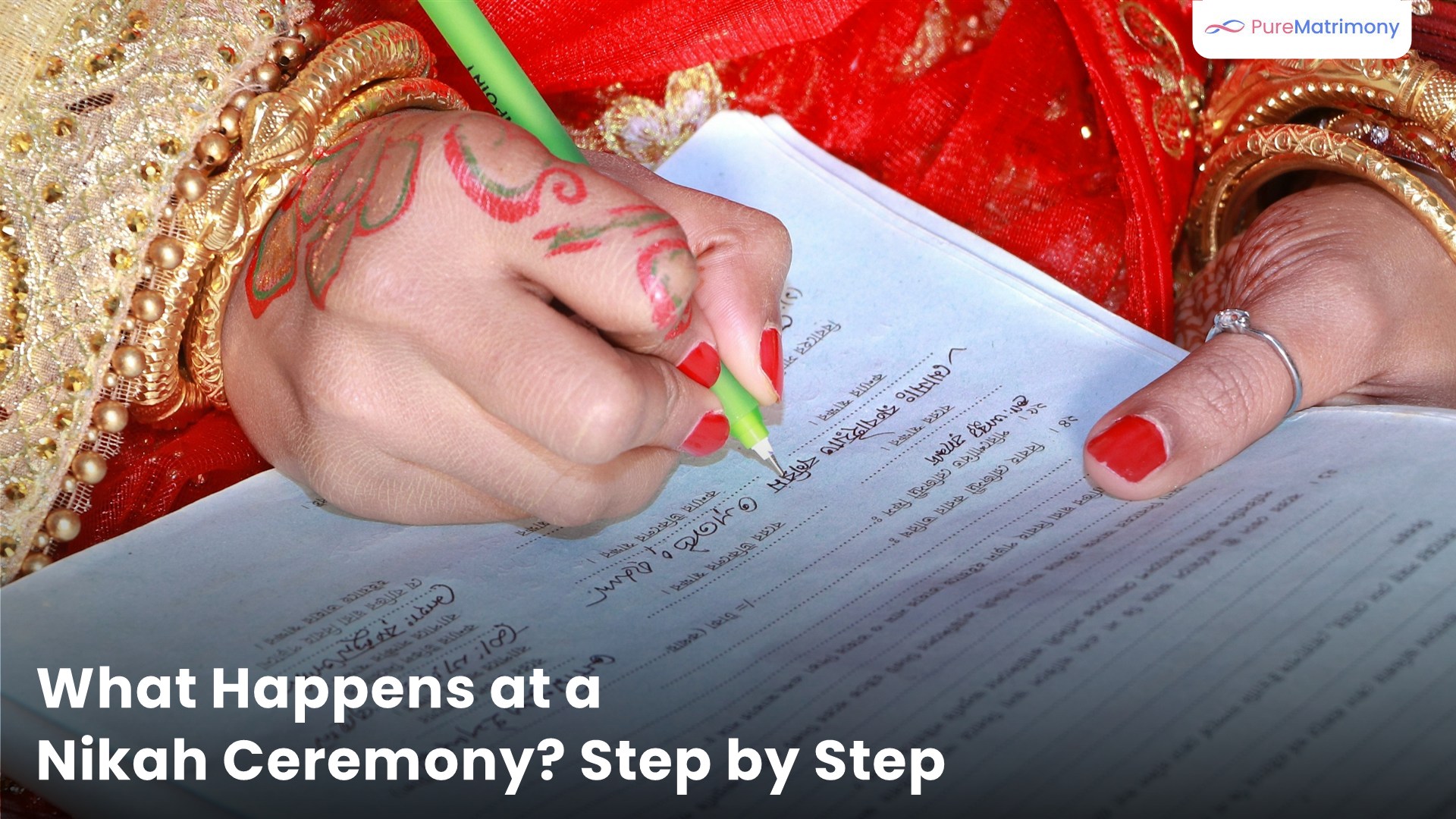
A Nikah ceremony follows a simple order: a short opening sermon, confirmation that both bride and groom consent, the naming of the Mahr, then the offer and acceptance (Ijab and Qabul) in front of two witnesses, followed by signing and a closing dua. The contract itself takes only minutes, and most ceremonies last 30 to 40 minutes.
Much of what surrounds it, from the venue to the clothes to saying “Qubool hai” three times, is custom rather than requirement. Here is the full running order, for couples and for guests.

The Nikah Ceremony in Order
1. The Khutbah (Opening Sermon)
The ceremony usually opens with a short sermon from the imam or another knowledgeable person. It is normally the Khutbah al-Hajah, the address the Prophet ﷺ taught his Companions, which begins by praising Allah and seeking His help (Sunan Abi Dawud 2118, graded sahih by al-Albani). It often includes verses on taqwa and a reminder about the rights of husband and wife. The sermon is a Sunnah, not a condition of the marriage: IslamQA states that it “is sunnah, not waajib (obligatory)” (IslamQA 2068). It usually takes five to ten minutes.
2. Confirming Consent
The imam then checks that both parties agree to the marriage. The groom is usually asked directly. The bride is often asked privately beforehand, frequently by her Wali and two witnesses, and her answer is reported to the gathering. This is not a formality. A marriage the bride has not agreed to can be annulled, as the Prophet ﷺ did for Khansa bint Khidam (Sahih al-Bukhari 5138). A careful imam will want to be sure the bride’s agreement is her own.
3. Naming the Mahr
The agreed Mahr, the gift from the groom to the bride, is stated aloud so the witnesses hear it. The imam will usually say whether it is paid now, deferred, or split between the two. Agree it before the day so this moment is a confirmation, not a negotiation. The options are set out in our Mahr guide.
4. Ijab and Qabul (Offer and Acceptance)
This is the moment the couple become married. The bride’s Wali, or a representative acting for her, makes the offer, for example: “I give you my daughter in marriage for the agreed Mahr.” The groom replies that he accepts. In many South Asian families the groom, and sometimes the bride, says “Qubool hai” (“I accept”) three times. That repetition is a cultural custom. One clear acceptance is what the contract needs. Islamweb notes that the bride does not even have to pronounce the acceptance herself when her Wali concludes the contract with her consent (Islamweb 281371).
5. The Witnesses
At least two witnesses must see and hear the offer and acceptance. They are what makes the marriage public and provable. Many families choose one trusted adult Muslim man from each side. Their names go on the certificate.
6. Signing and Dua
The Nikah certificate is signed by the groom, the bride or her Wali, the witnesses and the officiant. Everyone then makes dua for the newlyweds, and many recite the Prophet’s own wedding dua, “Barakallahu laka”. Our dua for marriage guide gives the full Arabic and meaning. Sweets or dates are then often shared, especially in South Asian and Arab families.
What Is Required and What Is Custom
Many wedding guides list everything that happens on the day as if it were all part of the religion. It is not. This table separates the two.
| Needed for a valid Nikah | Customary, not required |
|---|---|
| Free consent of the bride and groom | The opening sermon (a Sunnah) |
| A clear offer and acceptance | Saying “Qubool hai” three times |
| Two witnesses | Holding it in a mosque |
| A Mahr for the bride | Rings, flowers, outfits and stage decor |
| The bride’s Wali (in the majority of schools) | Sweets, dates and photography |
Customs are not wrong, and many carry real meaning for families. The point is to know which parts carry the marriage, so a cultural detail never causes worry about whether the Nikah counts. Each condition is explained in our guide to what a Nikah is. If anything about your own situation is unusual, ask the imam conducting the ceremony.
How Long Does a Nikah Take?
The offer and acceptance on their own take a minute or two. With the sermon, the consent, the Mahr, the signing and the dua, a typical ceremony runs 30 to 40 minutes. Cambridge Central Mosque, for example, books a Nikah for 1 hour 15 minutes, with the ceremony itself taking “approximately 30-40 minutes” and the rest of the time for greetings and photos (Cambridge Central Mosque).
If the Nikah is part of a larger event at a hall, allow extra time for guests arriving, for separate seating to settle, and for family photographs afterwards.
Where Can the Nikah Take Place?
Because the Nikah is a contract, it does not have to happen in a mosque. In the UK, couples hold it at a mosque, at home, in a community hall or at a wedding venue. What matters is that the conditions are met and a knowledgeable person conducts it.
Each option has a practical side. Many mosques have a resident imam and a set booking process, and some charge a donation or fee. A Nikah at home is simple and private, but you will need to arrange the imam and witnesses yourself. Venues often hold the Nikah and the reception in one place. Whichever you choose, ask early about what the imam will need from you: ID, the Wali’s details, the Mahr and the names of the witnesses.
Does the Nikah Make You Legally Married in the UK?
A Nikah makes you married in Islam. Whether it also makes you married in English and Welsh law depends on how and where it is held. Under GOV.UK guidance, a religious wedding is a legal marriage when it takes place at a registered religious building and an authorised person attends and signs the marriage schedule (GOV.UK). Many mosques are not registered. Cambridge Central Mosque, for instance, says it is not authorised to conduct civil ceremonies, so couples arrange those with their local registrar. Most couples therefore hold a civil ceremony as well, before or after the Nikah.
What to Expect If You’re a Guest
If you have been invited to a Nikah and have never been to one, here is what to expect:
- Dress modestly. Loose clothing covering arms and legs. Women attending at a mosque are usually asked to cover their hair, so bring a scarf.
- Shoes off in the prayer area. At a mosque, there will be racks or a space to leave them.
- Seating may be separate. Men and women often sit in different areas, especially at a mosque.
- It is short and quiet. Expect a sermon in Arabic and English, a few minutes of formal words, and dua. There is usually no music during the ceremony itself, and no alcohol at any point.
- Non-Muslim guests are welcome. You can attend and celebrate. Islamweb notes that a non-Muslim’s presence does not affect the marriage, though a non-Muslim cannot be one of the official witnesses (Islamweb 281371).
- Congratulate the couple afterwards. A simple “Mubarak” or “Congratulations” is perfect. Gifts, often money in a card, are usually given at the reception.
After the Nikah
The Walima, the wedding meal hosted by the groom’s side, follows the Nikah. Some families hold it the same day, others weeks or months later. The Prophet ﷺ told Abdur-Rahman ibn Awf, “Give a banquet, even if with one sheep” (Sahih al-Bukhari 5167), so the Walima should fit the couple’s means. If the couple have not yet discussed how married life will work, now is the time; our guide to the engagement conversation covers what to talk about.
Still Looking for the One to Share Your Nikah With?
Every Nikah starts with finding the right person. On Pure Matrimony, practising Muslims search for a spouse with their families involved, so the path from first conversation to Nikah stays open and halal. Create your free profile, and see our 50 questions to ask before marriage when you meet someone.