
What is a Walima? The Sunnah Wedding Feast Explained
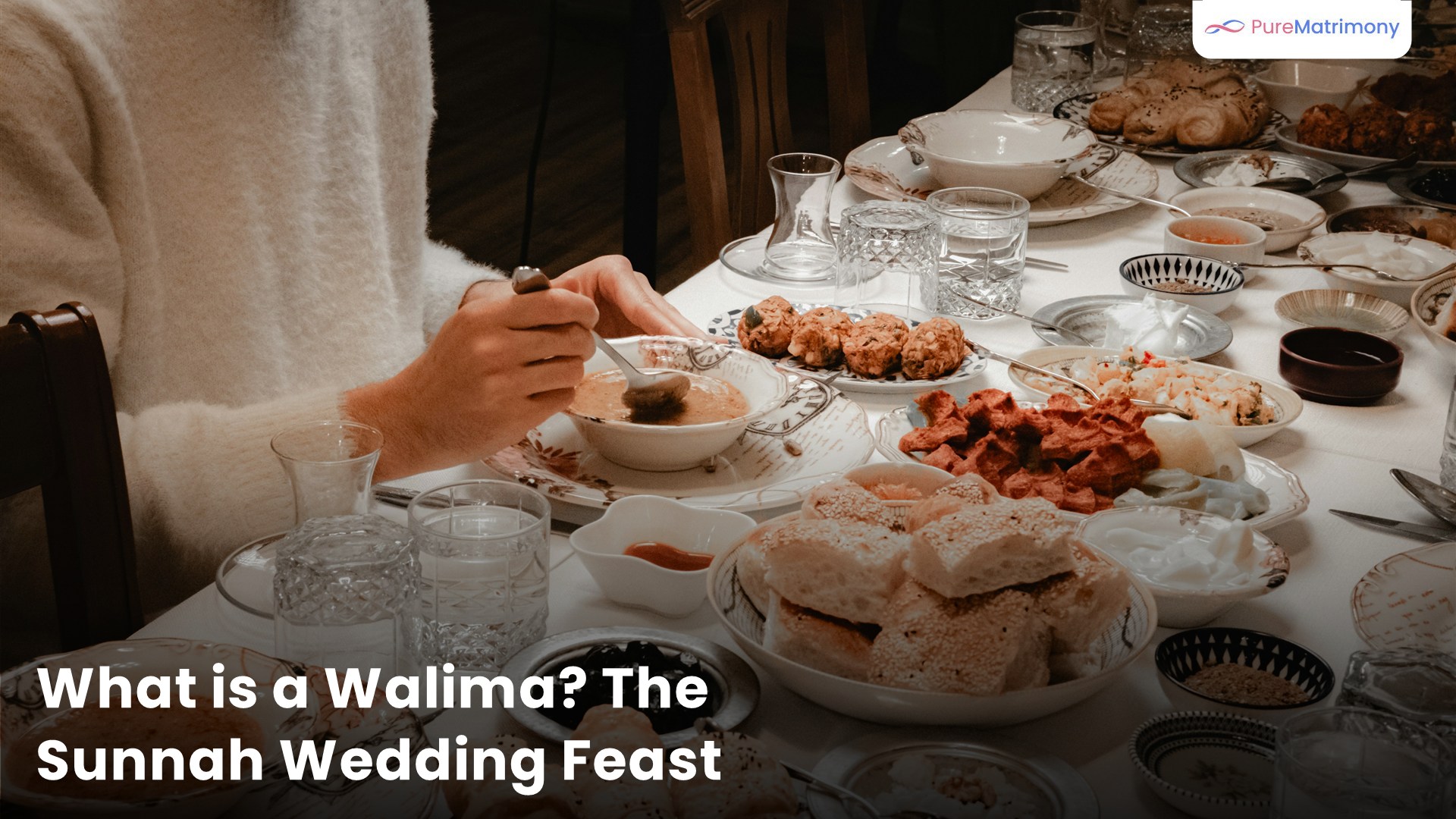
A Walima is the wedding feast the groom hosts after the Nikah, to thank Allah and to let people know the couple are married. Most scholars regard it as a strongly recommended Sunnah rather than an obligation, so a marriage is valid without one.
It does not need to be grand: the Prophet ﷺ held Walimas with a single sheep, a sweet dish of dates and butter, or a little barley, and a simple meal shared with family, friends and people in need fulfils it.

What Does Walima Mean?
Walima comes from an Arabic root linked to gathering and coming together, and in Islamic usage it means the meal given to celebrate a marriage. You will see it spelt Walima, walimah and waleemah. All three refer to the same thing.
The Walima has two purposes. The first is gratitude: a marriage is a blessing, and feeding people is a way of thanking Allah for it. The second is announcement: a marriage in Islam is meant to be known, not hidden, and a meal where relatives, neighbours and friends gather makes it public in the most natural way.
The Walima is separate from the Nikah. The Nikah is the contract that makes the couple married; the Walima is the celebration that follows. Our guide to what a Nikah is explains the contract itself and the conditions for it to be valid.
Is the Walima Compulsory in Islam?
According to the majority of scholars, the Walima is a Sunnah, not an obligation. Islamweb states that “according to the view of the majority of the scholars, organizing a Waleemah (marriage banquet) is a Sunnah and not an obligation” (Islamweb 128221). A minority of scholars considered it obligatory, because the Prophet ﷺ gave the instruction as a command.
That instruction came when Abdur-Rahman ibn Awf told the Prophet ﷺ he had married. The Prophet ﷺ asked about the Mahr and then told him to hold a wedding banquet “even with one sheep” (Sahih al-Bukhari 5167). The words “even with” set the tone for everything that follows: the Walima is expected, but it is measured by what the groom can afford, not by what others expect.
Two practical points follow from the majority view:
- The marriage does not depend on it. A couple whose Nikah met its conditions are married whether or not a Walima has taken place.
- It should still not be dropped lightly. It is a Sunnah the Prophet ﷺ practised at his own marriages and urged on his Companions, and it carries real blessing.
Guests also have a duty. The Prophet ﷺ said: “If anyone of you is invited to a wedding banquet, he must go for it” (Sahih al-Bukhari 5173). Scholars set conditions on this, which the FAQ below covers.
When Should the Walima Be Held?
There is room for flexibility. IslamQA explains that the best time is after the marriage has been consummated, following the example of the Prophet ﷺ, but that scholars also allow it before consummation or soon after the Nikah, depending on custom and what the family can manage (IslamQA 131252).
Islamweb notes that some jurists of the Shafi’i school allowed the Walima to be held even after a period of marriage has passed (Islamweb 128221). So a couple whose Walima was postponed, for example because of a bereavement, can still hold one later.
In the UK, timing usually follows practical needs. Some couples hold a small Walima the day after the Nikah; others wait until the bride has moved in, or combine it with a larger reception weeks later. Any of these can fulfil the Sunnah. What matters is the intention behind it and keeping it within your means.
Who Pays for the Walima and Who Should Be Invited?
The Walima is the groom’s responsibility. IslamQA states that “the basic principle with regard to the wedding feast (waleemah) is that it should be organized by the husband”, because the instruction was given to the husband (IslamQA 138358). The same answer accepts that it can be organised jointly by the husband and the bride’s family. What should not happen is the bride’s family being pressured into paying for a celebration that Islam asks the groom to provide.
On the guest list, one hadith matters more than any other. The Prophet ﷺ described “the worst food” as “that of a wedding banquet to which only the rich are invited while the poor are not invited” (Sahih al-Bukhari 5177). A Walima that only gathers the well connected misses the point. In practice, that can mean:
- inviting neighbours and people from the masjid, not only family and colleagues
- making sure relatives who are struggling financially feel just as welcome
- sending food to families who could not attend, or donating part of the meal
IslamQA adds that there is no set number of guests: it depends on what the host can afford.
Sunnah vs Culture: What a Walima Needs and What It Does Not
Over time, many communities have added layers to the Walima that are not part of the Sunnah. Some of these carry real meaning for families, and none of this is a criticism of celebrating. But it helps to know which parts are the Walima itself and which are optional extras, especially when costs start to climb.
| What the Sunnah asks for | Cultural extras (optional) |
|---|---|
| A meal provided by the groom | Large banqueting halls and stage decor |
| Gratitude to Allah for the marriage | Multi-course menus and catering competitions |
| Announcing the marriage to family and community | Separate events on several days |
| Inviting the poor as well as the rich | Matching outfits, themes and favours |
| Keeping it within the groom’s means | Taking on debt to meet expectations |
The Prophet’s own Walimas show how simple it can be. When he married Zaynab, his most generous Walima was a single sheep (Sahih al-Bukhari 5168). When he married Safiyya, the Walima was hais, a sweet dish made from butter, cheese and dates (Sahih al-Bukhari 5169), and Anas described it as a banquet “which included neither meat nor bread” (Sahih al-Bukhari 5159). For some of his marriages, it was two mudds of barley (Sahih al-Bukhari 5172).
If expectations around the wedding are being pushed onto the bride’s family, our guide to Mahr vs dowry explains why that reverses what Islam teaches.
How to Host a Simple, Debt-Free Walima
- Set the budget before the guest list. Decide what the groom can afford first, then invite within it, not the other way round.
- Choose a modest venue. A masjid hall, a community centre, your home or a garden all work. Many mosques hire out halls at low cost.
- Keep the menu simple. One good main dish, dates and drinks is enough. Ask relatives who cook well to help instead of hiring caterers for everything.
- Invite people in need. Include neighbours, masjid regulars and anyone who would otherwise be left out.
- Plan seating your guests will be comfortable with. Many families arrange separate areas for men and women. If you are unsure about entertainment, music or seating, ask a scholar you trust before the day rather than after.
- Share what is left. Send leftovers to neighbours, a local shelter or families who could not attend.
- Agree it early. Talk through the Walima, the budget and who pays during the engagement, so no one is surprised later.
Start With the Right Person
The simplest Walimas usually come from couples who agreed early on what matters to them. On Pure Matrimony, practising Muslims look for marriage with their families involved, so conversations about the wedding, the costs and the Sunnah happen from the start. Create your free profile, and use our questions to ask before marriage to cover the practical side.